Showing posts with label gemstones. Show all posts

Beading mania by Patrizia Tager

 
Interview with jewelry artist Patrizia Tager

Our guest today is incredibly talented bead artist from Israel Patrizia Tager (Triz), she was very kind and agreed to answer our questions. We believe that you'll be glad to know Patrizia and read her short story on her passion, the name of which is beading! Thank you, Patrizia!

1. Triz, where are you from and where do you live now?

I was born in Milan, Italy where I lived till I was twelve. My mother is French and my father is British, and when I was 12 my family moved "back" to England. After graduating from college at the age of 22, I decided to move to warmer climates, as I cannot stand cold and rainy weather, so I moved to Israel, where the sun shines eleven months of the year. I'm still in Israel today.

2. What is your education and occupation?

I graduated with a B.A. Hons in Fashion Design from the American College in London (renamed The American Intercontinental University, London). I studied photography for two years in Israel and then in my perpetual quest to find myself, I went on to study Social Policy and Criminal Justice. I currently work as a desktop publisher for a medico-legal publishing house as well as working on my own beadwork and teaching intermediate/advance bead embroidery workshops.

3. When did you start crafting and what was your first craft?

This is so difficult to answer! I've always, as far as I can remember, been doing one form of craft or another. This is mainly due to the wonderful nanny, Paola, that looked after my sisters and I when we were little. She was with us for many years and was incredibly talented and resourceful. We used to make hand puppets and create the most beautifully decorated puppet theatres all made out of cardboard boxes. She also taught me to knit and to crochet and, in fact, introduced me to my early experience with beadwork by showing me how to make a loom out of a shoe box and taught me to make loom-woven beaded bracelets. Coming from a completely artistically-challenged family, she was my artistic angel sent from above. She ncouraged, praised and inspired me.

4. How did you come to beading? What inspired you?

As I mentioned above, I was introduced to beading by our nanny Paola, however those days were long forgotten once I moved to London and it wasn't until about 3.5 years ago that I was reintroduced to this wonderful world of beads. When my son turned one and started attending day-care a couple of times per week, I found myself desperate to get out of the house for a few hours and do something creative. The local shopping center had a beading shop and I went in to enquire about taking some classes. I took four basic beading classes, where I learnt to make a beaded ball and a couple of other beginner's projects. I became completely and utterly hooked with this medium. It was as though I found myself, finally! The four classes weren't enough, I desperately wanted more, so I went out and bought every magazine and book I could find on beadweaving and for a year I spent all of my free time trying out different techniques. It became my true passion verging on obsession.

5. How did you learn making your beadart works?

During my "learning" year I researched the subject extensively, especially on the Internet and became familiar with some wonderful bead artists. I discovered a whole world that I did not know existed and became aware of the endless possibilities of creating with these tiny little beads. I applied my earlier knowledge of design to this new medium which led to the creation of my own original pieces.

6. How is main work associated with beading? Does it help you to bead?

Sadly my "real" job has no associations whatsoever with beading and in fact it is an encumbrance to my creative flow and designs, but it's a job and it pays the bills.
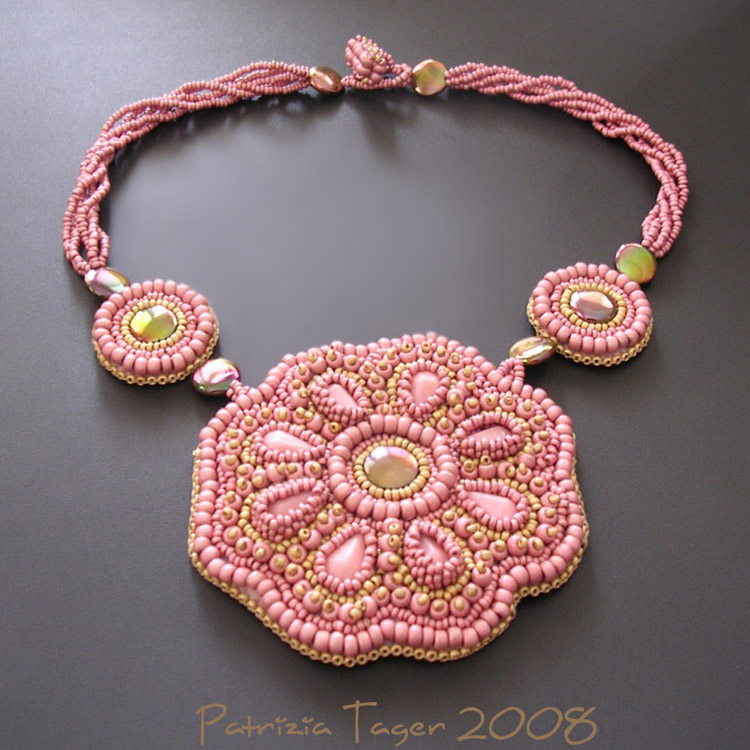

7. What are your favorite techniques and media? Why?

Frankly, I love all the techniques I have learnt so far. Some I may find easier to execute than others, but if I had to choose a favorite it has to be bead embroidery. I love the freedom it allows. Whenever I'm bead-embroidering I feel as though I'm painting with beads. I see the beads as my paint and the various sizes and finishes of the beads as my brushstrokes. I find this technique incredibly liberating.

8. Are there any bead artists you try to follow?

There are so many bead artists that I'm truly in awe of, my favorite by far is Sherry Serafini. I think her work is not just stunningly beautiful but also genius. Her attention to detail and her workmanship are superb !!! David K. Chatt's beaded sculpture and jewelry are out of this world! The Lone Beader's amazing beaded artworks always leave me inspired and amazed at her creativity, originality and execution of her gorgeous art!
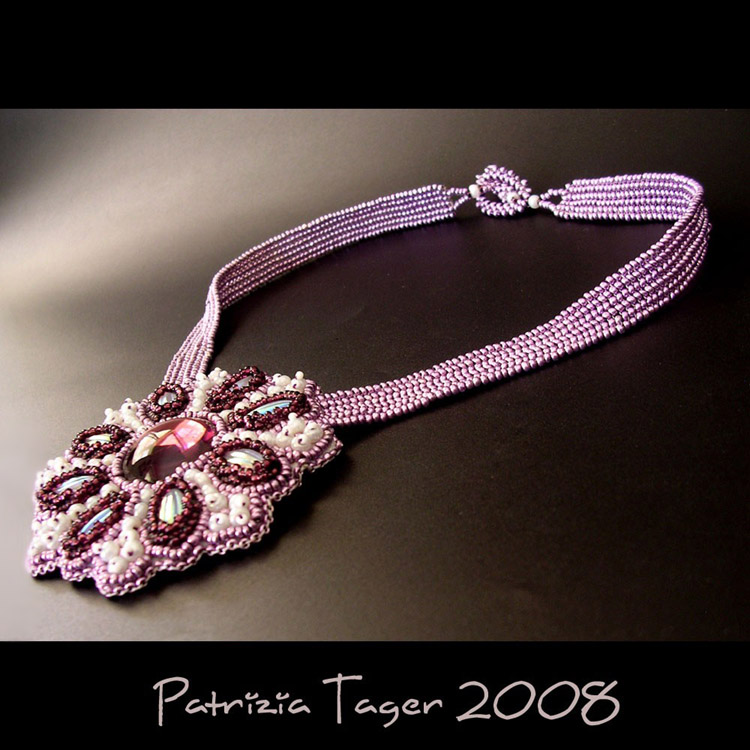

9. Where do you find images for your beadwork?

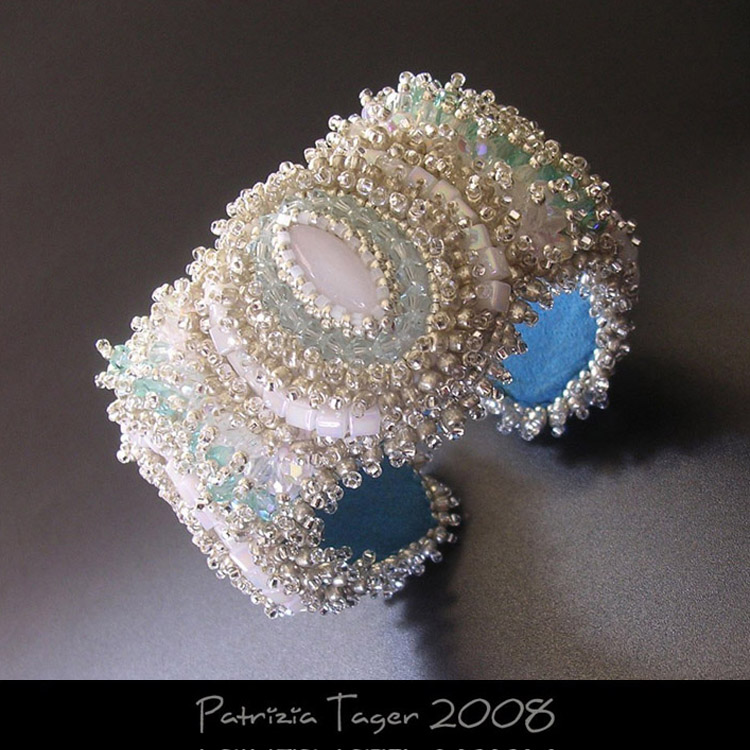
Absolutely everywhere; I look at everything: nature, architecture, antiquities, fashion, fabrics, art, colors, and other bead artists. By far my greatest inspiration comes from my own memories and life experiences - e.g.: my latest finished pieces, Frozen Waters Cuff and Frozen Waters Earrings were inspired by my childhood memories of holidays in the Swiss mountains - the colors, the brightness, the reflections, how the incredibly clear blue skies reflected off the snow and the frozen lakes. Obviously the memories are idyllic rather than factual, as I haven't been to Switzerland in over 20 years nor have I seen snow in over 10, but from those memories I get snippets of inspirations which I then translate into my work.

10. What do you think is your greatest achievements in beading?

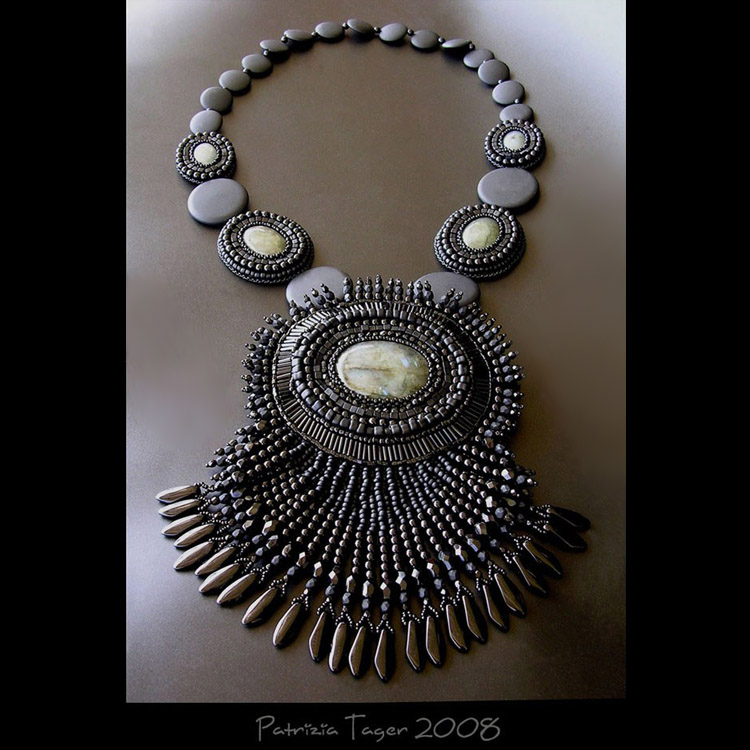
My greatest achievement is winning the last two EtsyBeadWeavers' challenges for my works Let My People Go and
Black Panther!!! I'm so grateful that people like my work enough to vote for it! I'm also proud of how far I've come using this medium in such a short space of time!
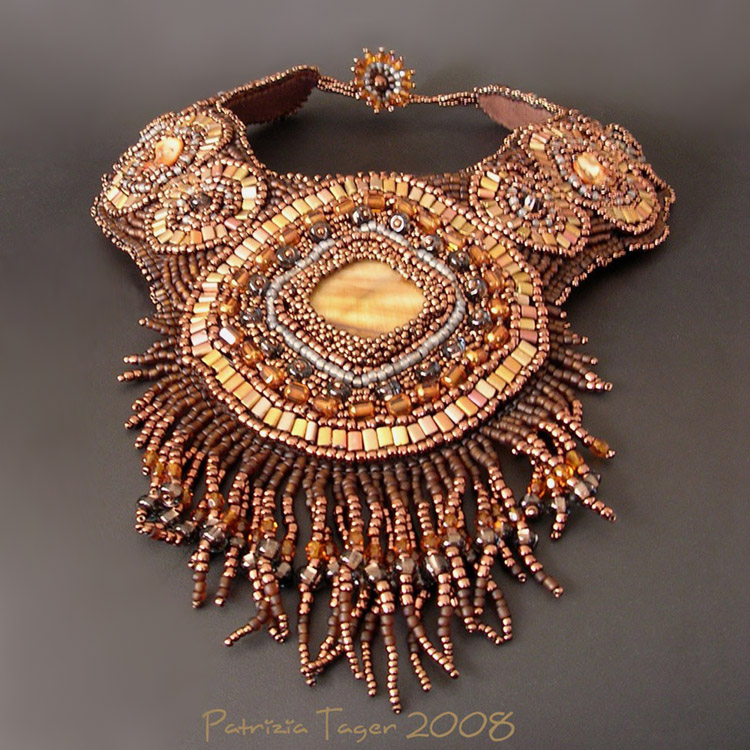

11. What do you plan to improve in the future?

There is so much I still want to learn, for example, I have never tried the Russian stitches and I love how they look, I just haven't got round to trying them out yet! I learn something new every time I create a new piece - new challenges arise with each new design, I always strive to make my next piece better than my previous one. I see my beadwork as a learning journey, much the same as life!

Thank you, Patrizia! We wish you best of luck and a great success!

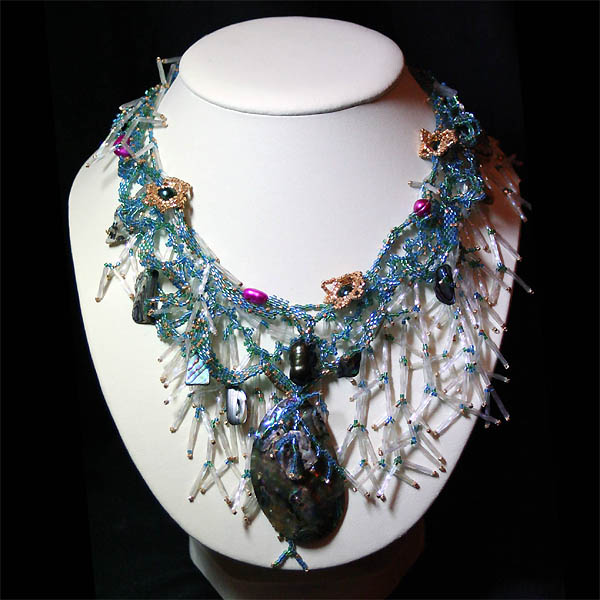
Beaded jewelry by Patrizia Tager


About artist:

Patrizia Tager, Herzlia, Israel
E-mail address: patriziatager@hotmail.com
Blog: triz-beadingmania.blogspot.com
Etsy: Triz Designs


AddThis Social Bookmark Button

Beaded jewelry by Jama Watts

Jama Watts was born, raised and currently lives in Kentucky. She was introduced to art as most kids, in elementary school. "Getting to go to the art room in elementary school was always something special for me," Jama said. "I loved getting my hands dirty with clay, painting and drawing. But, since my dad was an engineer and I was good at math, I always thought I'd be an architect."

Watts took mostly construction, drafting and other classes in middle and high school, but during the summer of 1992 she began to focus on drama and the arts, and later Jama decided to study art in college. After graduating from college Jama has spent a few years working in jobs that had nothing to do with the arts. In 200 Jama had a life-changing moment: needing a creative outlet, she began stringing beads and making rosaries to pass time. She is a self-taught beader, learning through books, magazines and experience.


Shortly after her daughter, Amber, was born, Jama left her office job and opened a small art gallery and coffee bar in Lebanon. The gallery, These Precious Things, represents 30 central Kentucky artists, allowing Jama to spend "down time" making jewelry at her desk.

The ideas for her pieces come from a variety of sources. She has a slight addiction to beading magazines and books but most of her inspiration comes from a background in painting, sculpture and nature. She loves color and texture, which shows in her jewelry. Jama often begins a piece as a way to examine a new stitch or color palette then lets the piece tell her where it wants to go. Her favorite work is in freeform beading as she feels it allows her to express herself more freely.


Jama has come to think of her pieces as "wearable art" rather than "just jewelry," which she feels allows her greater creativity when designing and working on her pieces. Watts' work is also a reflection of what she's into or going through at the moment she makes the piece. Music, emotions and paintings are starting points for many pieces, as is the desire to test out a new stitch.

"I'm very ADD when it comes to my craft, learning new techniques constantly and playing with the results," she said. "I guess you could call it contemporary tradition! I do everything from pieces that look vintage to incorporating computer and watch parts into my pieces."


Watts has ventured into cold-connected metal work, wire wrapping and silver clay but always returns to the beads, elaborating on traditional designs and creating her own. Her work has been featured in many national and local magazines, media and Internet outlets. She also filmed a segment for HGTV's "That's Clever!" which is tentatively scheduled to air in February 2009. Jama is a winner of several awards for her pieces over the last few years, she is an active member of beading and art associations. She also enjoys teaching jewelry-making classes at the local community education center. Jama's work can be found in her own gallery These Precious Things in Lebanon, KY, as well as in several retail outlets throughout Kentucky.

An article by Jama Watts


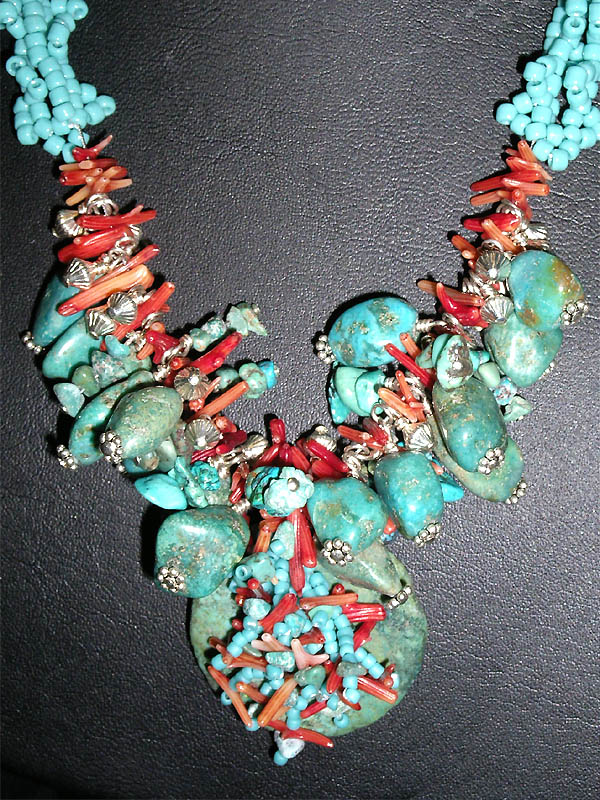
Beaded jewelry by Jama Watts


About artist:

Jama Watts, Lebanon, Kentucky, USA
E-mail address: jamama@gmail.com
Website: www.jamawatts.com
Gallery: www.thesepreciousthings.com
Etsy: www.thesepreciousthings.etsy.com
Blog: www.jamawatts.blogspot.com

AddThis Social Bookmark Button

Wirework jewelry by Carina Veling

 
Interview with wirework artist Carina Veling

Carina Veling lives in a small village in the Venlo region, in the south of the Netherlands, and has been making jewelry and other art for much of her life. When she was 14 years old she began to make jewelry, and has since ventured into many materials and techniques. Some of the techniques that she has used are wire wrapping, chainmaille, beadweaving, stringing, wire crochet, netting, and polymer clay as well as many others. We have known Carina for a long time, found her jewelry adorable. and asked her for an interview. She was so kind that agreed to answer all our questions. Thank you, Carina!

1. Carina, how long have you been making jewelry?

Hard to say, when I was 14 years or so I made earrings for myself and friends of mine (I think I still have them now - I'm kidding). The earrings were made using ballpoint springs and seed beads. Furthermore, I have done different things in the creative fields, such as 3D greeting cards, pergamano greeting cards, and embroidery on greeting cards. Then I discovered embroidering with beads on greeting cards. A few years ago I discovered www.wigjig.com and I bought my first hobby jig (a green plastic thing), and I made a few necklaces, earrings and bracelets with it.

2. What or who inspires you for that?

In December 2004, I became a member of the B&B forum, my first beaders' community and I was amazed by the work of many others. My heroes at that time were MEW (Middle Earth Wire), Totemic (John Wik) and Gwen Fisher. Lately I'm more active on the Starving Artists and Jewelry Artists websites, where I have met some more my favorite artists, among them are: Zoya Gutina, Jacksmom, Kvorrie, RubyBee, etc. Of course you can also find me on a few Dutch forums where I've also got a few favorites: Blackcrow, Miranda, Ineke, Armande, and CarolinaG, to count just a few.

3. Are you a self taught jewelry maker or have you taken classes?

I have never taken any classes. I was inspired and encouraged to try what I'm doing now by the work of the other artists. In my country there have been little to no workshops or classes. Everything I wanted to learn I had to collect from the Internet. So far this has been fine; I design my jewelry trying to follow my friends' and other artists' advice, and mostly I succeed with the first tries. If not, I keep going until I am successful.


4. Have you already chosen the particular type of jewelry to make?

Well, even now, I change my preferences. Today I like stringing, tomorrow I might start making some beaded beads and so on. At this moment I have returned to chainmaille and wire wrapping.

5. What kind of techniques have you tried?

You may ask what I have not tried. Yet, I'll try to give you a short list of things that I have done: wire wrapping, chainmaille, beadweaving, stringing, wire crochet, netting, polymer clay, etc.

6. Which technique do you like best of all and why?

The best techniques I found are wire wrapping and chainmaille. I do not know why, probably because they are soothing and relaxing.

7. What are your favorite materials?

Gemstones, sterling silver, silverplated artistic wire, crystals, copper wire. I can work with whatever is available, even plastic or acrylic beads when they are nice.

8. Do you plan your work or don't you know the result in advance?

As a rule, I make a drawing or a sketch of my new project, but when I start creating a new piece sometimes it appears to be not feasible and I have to make minor adjustments. In some cases, I know in advance what I want to make, but very often it ends up completely different as what I had in my mind before, usually better. Sometimes it can happen that I just start and let the beads and wire guide me.

9. How much time does a new item take you?

I don't know, it depends on what I'm making, it can vary from 15 minutes to a few hours.


10. How do you find the themes for your creations?

I think the most I get inspired by the work and ideas of others, but I change the design so they are completely different at the end. Often, photographs in magazines or on the Internet can inspire me for my items. Sometimes I see something in a store (even in a hardware store) or I find something during cleanup that makes me think: "Yes, I could use that for my design." This is what happened the last time, when I found a box with tap rubbers, which are now included in my chainmaille necklace and earrings.

11. How would you describe your style and the signature of your jewelry?

I do not know whether I have a style, let alone a signature. I just make what comes to my head. If you have a name for that, feel free to let me know.

12. What do you like in jewelry trends?

Not much, frankly, I do not pay attention to the trends, I make what I like. The disadvantage of trends is that everyone makes jewelry of the same look and very soon it becomes boring.

13. What jewelry style is your favorite?

Romantic Goth and Victorian, but in a modern twist.

14. Jewelry of which modern artists do you like and why?

I'm not fond of modern jewelry and I don't know the names of the artists who make modern jewelry. But I do love the work of Raven Eve, mainly because of the style and because she is not afraid of using the materials she uses.

15. Do you participate in any jewelry design contests and exhibits?

Sometimes I do participate in contests, but more for fun and to see how I can be creative to compare to the other artists than to win. Exhibitions seem to be fun, unfortunately there are no opportunities in my region for that, or I have not looked for them well enough.

16. Do you sell your jewelry and where?

I've made just a few tries to sell my jewelry. I've sold my creations at a hairdressing sallon for a while, and actually I sold a couple of necklaces. My coworkers bought a few pairs of earrings and bracelets. Now I'm redesigning my website so that it would be more commercial and easier for my potential customers. The url will be the same as it is now.


17. Do your family and friends support your jewelry making passion?

My boyfriend (partner) thinks it takes too much space, but he helps me with the web design. Otherwise the things associated with my jewelry making will take much more time. My mother thinks my creations are absolutely fantastic and almost all the time when I come to see her she has my jewelry on. Even my daughter began to like and wear my jewelry!

18. What do you feel when jewelry making? Does it help you in your life?

Sometimes I'm very relaxed, and sometimes I get stressed out, but generally I enjoy the process. It still has an advantage, as long I'm busy with making jewelry I forget to snack. Disadvantage is that I forget that I have to eat or drink, and even worse, that my family would like to eat as well. It also helps me in real life, it makes my self image better and builds up my self-esteem.

19. Do you want to try something new? What do you plan for the future?

I would love to try making glass beads and/or make something with precious metal clay; I also want to try working with sheet metal. For the foreseeable future I am going to redesign my own website and do web design in collaboration with my partner. We would like to design and to develop affordable web shops, first of all, for bead hobbyists.

Thank you, Carina! We wish you best of luck and a great success!

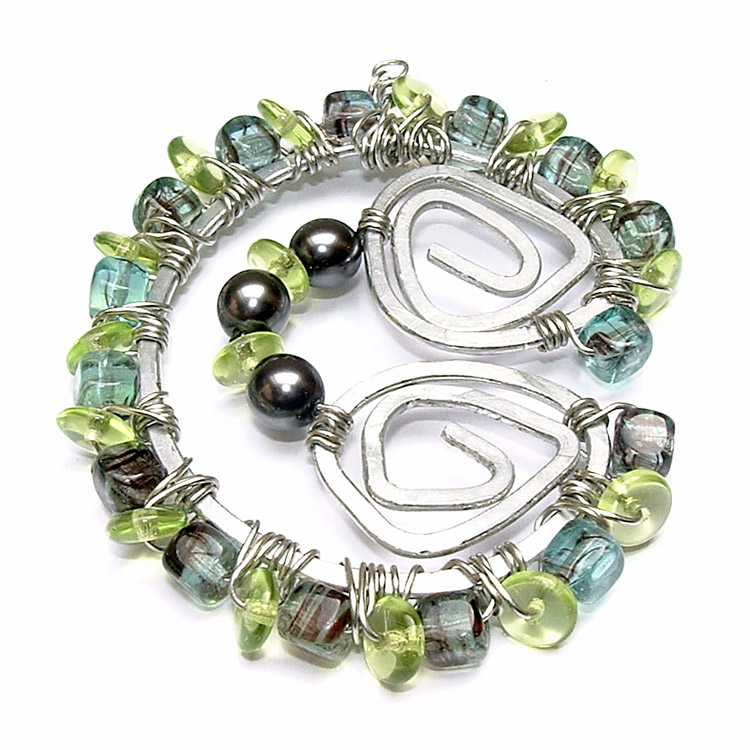
Wirework jewelry by Carina Veling


About artist:

Carina Veling, Venlo region, the Netherlands
E-mail address: violetmoon.nl@gmail.com
Website: www.violetmoon.nl

AddThis Social Bookmark Button

Carats Vs Karats: What is the difference?

Carats Vs Karats: What is the difference?
If you are in the business of using, buying or even wearing gemstones and precious metals, you should be aware that these two words mean very different things. Shopping for jewelry, findings and materials should make much more sense after you read this article about Carats vs Karats.

Carat
A Carat is a weight measurement in reference to precious gemstones such as Diamonds, Sapphires, Rubies, etc. Many people think a carat is referring to the size of the gemstones, however, it is a measurement of weight. While the weight does effect the size of the gemstones, a carat is not a measurement of length, mass or volume. The Carat, along with the purity of the gemstone is what determines the price of the precious stones.

Karat
A Karat is the measurement of the purity of gold. Gold itself is very soft, and like silver, it needs to be alloyed with other metals to make it stronger and less expensive. 24 karat gold is considered pure gold, or 100% gold. While many people think 24 karat gold is the best quality you can buy, the soft metal is less durable and it can scratch or damage easily. To prevent this, gold is alloyed with metals such as silver, copper and zinc. When producing white gold alloys, nickel, copper and zinc are used. So, the karat is measured by the ratio of gold to the alloyed metal. 18 karat gold is 3/4 gold or 0.750 gold, 14 karat gold is 14/24 gold or 0.583 gold, etc.

Although the karat does determine the value of the gold, it does not tell us the price we are paying for gold. After you have determined the karat of gold you would like, the final step in determining the price of your gold is it's weight, how much gold are you purchasing? Precious metals are measured in Troy Ounces, one Troy Ounce is equal to about 31.1 grams. There are 12 ounces per Troy pound. Oh yea, and did I mention that the price of precious metals is variable?

Visit www.kitco.com/market/ to find out the current prices of precious metals. Or you can visit http://goldprice.org for the current gold pricing information.

KINCAIDESIGNS is proud to use 14 karat gold filled materials and sterling silver material in their Unique Handmade Jewelry. What is Gold Fill? Gold-filled, or gold overlay, is made by heat and pressure-bonding a thin layer of gold to a brass core. The gold covers the brass surface, making it tarnish resistant. The value of gold-filled is greater than gold-plated because gold-filled has an actual layer of gold, not just a microscopic film. All the 14kt gold-filled materials used by KINCAIDESIGNS handmade jewelry meets federal standards for quality and content.

Go Shopping for Unique Handmade Jewelry using Sterling Silver and 14kt Gold Fill: Handmade NecklacesHandmade Bracelets • Handmade EarringsHandmade RingsHandmade PendantsHandmade Bridal JewelryHandmade Seasonal JewelryHandmade Baby JewelryHandmade Jewelry Gift CertificatesVisit the Online Handmade Jewelry Boutique...

What is a Pearl?

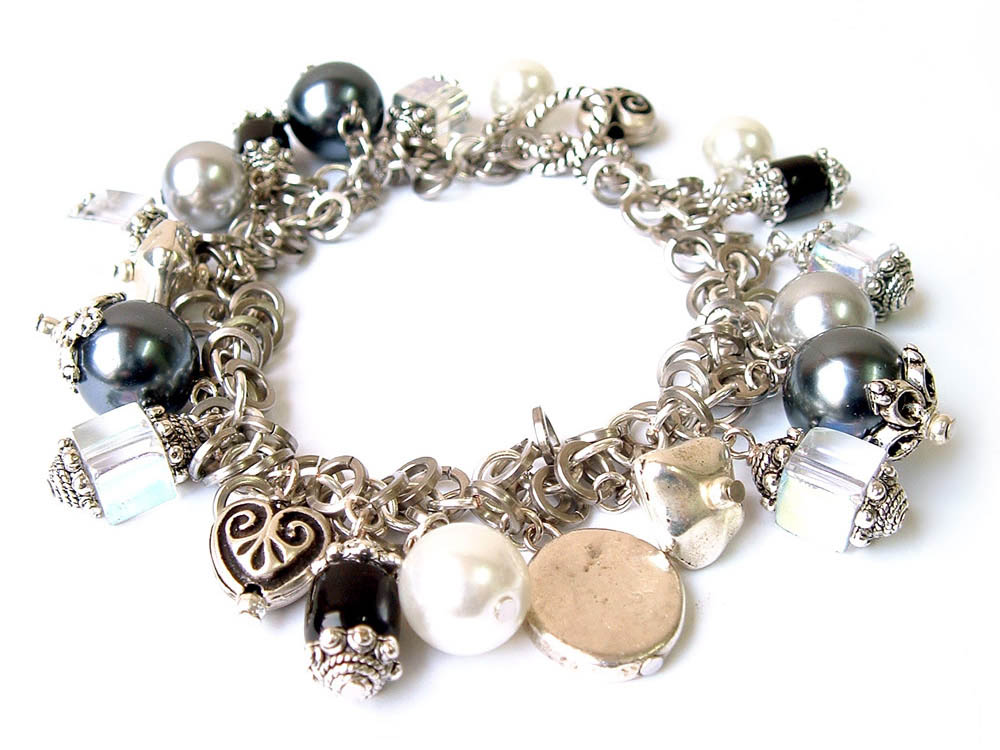
Handmade Pearl Bracelet with Blue TopazPearls have been valued for their beauty and rarity for thousands of years. They are considered biological based gemstones and have records in ancient cultures for much longer than any other gemstones. Unlike other your stereotypical gemstones, pearls do not have to be cut and polished, they are ready to wear in their natural form. Pearls can be used and worn in a variety of ways. While the most traditional way to wear pearls are strung together on one strand, many jewelry designers are using them as accents and unique elements in their unique jewelry designs. (Top Left: Kincaidesigns Handmade Jewelry Photo: Handmade Bracelet with Pearls, Swarovski Crystals, Blue Topaz and Sterling Silver.)

How is a Pearl formed?
Pearl is a concretion formed by a mollusk and consisting of the same material as the mollusk's shell, which is the mineral aragonite (calcium carbonate). In addition to aragonite, the shell contains small amounts of conchiolin, a hornlike organic substance; together these are called nacre, or mother of pearl. The finest pearls are those produced by mollusks whose shells are lines with mother of pearl. These mollusks are limited to a certain species of saltwater oysters and freshwater clams. The mollusks body tissue is called the mantle, and when a foreign particle enters the mantle, the cells build up more or less concentric layers of pearl around it to protect the mantle. Pearls are valued by their translucence, luster, surface color and shape. Since most natural pearls are irregularly shaped, the round or spherical pearl are highly prized.

It is very uncommon for an oyster to produce a natural pearl. Of the small percentage of those oyster that do produce a natural pearl, only a few of those will develop a desirable pearl in shape, color and size. Only about one in ten thousand oysters will naturally produce a gem quality pearl. As pearls have been valued and desired by so many people, the need has lead to the production of cultured pearls. Actually, the cultured pearl industry has far surpassed the natural pearl industry. Natural pearls are becoming harder to find, and the demand for pearls is too great.

Are cultured pearls fake pearls?
No, a cultured pearl is an artificially created pearl, but they are still real pearls. Instead of the foreign substance entering the mollusk naturally, the foreign object is manually inserted into the mollusk and returned to the sea, allowing the pearl to develop naturally. This method not only allows pearls to develop naturally, but their shape can be easily targeted by the placement of the foreign substance.

The method for cultured pearls is used for many, if not all types of pearls.


What determines the shape of pearl?
Since pearls form naturally, pearls can come in many unique and interesting shapes. Although we associate pearls to be round, it is actually very uncommon and rare to find a perfectly round pearl. The shape of a pearl is determines by a number of variable factors, including the shape of the nucleus the pearl is formed in and the placement of the developing pearl in the mollusk. A pearl usually takes the sa
me shape of the nucleus, so if the nucleus isn't perfectly round, the pearl won't be either. It will take on the irregular shape of the nucleus. The placement of the developing pearl will also effect its shape, for example: If the pearl is positioned against the shell of the mollusk, the pearl will be flat on one side. There are three basic categories for pearl shapes, Spherical (or perfectly round), Symmetrical (balanced and regular, but not round), and Baroque (irregular and abstract, there is no symmetry to these pearls.) There are many pearl shape variations within these categories as well. The shape of a pearls is one of many factors in determining a pearls quality and value. The round pearl being the most valuable, followed by symmetrical shapes and finally baroque. However, the unique shapes to baroque pearls are increasingly desirable, as these pearls are one of a kind.

How can I tell if a pearl is real?
There are two types of genuine pearls, natural and cultured pearls. A fake pearl can be simulated, faux, plastic, resin, glass or artificial. There are some tests you can do to pearls to see if they are real or fake, however, the best test is to bring them to a certified professional. It's not always easy to tell these pearls apart.

Have you ever seen someone pick up a strand of pearls and bite them? They were making sure they were buying real pearls. Since a real pearls are made up of layers of nacre, the surface will be gritty against your teeth. A fake pearl is usually smooth. However, this method isn't as reliable as it used to be, some fake pearl manufacturers are adding a coating to their pearls to simulate the gritty feeling on your teeth. In addition, pearls are all so different and unique, you might even find some pearls to be more smooth than others, even through they are real.

If you have a strand of pearls, take them outside into natural daylight. Real pearls will not all be same color under the sun, unless they are very expensive. You should be able to see slight variations in their iridescence and color. If they are perfectly matched, they probably aren't real.

You can magnify your pearls as you would a diamond at a jewelry store. You should be able to see the ridges and irregularities of a pearl. If the surface is smooth or lack irregularities, your pearls may be fake.

Real pearls also tend to be more dense than plastic, resin or hollow pearls. Good glass pearls might have the same density and you may not want to rely on this method of testing. But you should be able to tell right away if the pearls are plastic, resin or hollow.

Look at the holes drilled in your pearls. The nacre of fake pearls tends to flake away in the area where the holes were drilled. While the nacre could possible flake away on a cultured pearl, even though it's real, it will not flake away on a natural pearl.

Finally, you could have the pearls tested by a certified professional. They will not only look at your pearls under magnification, but they will x-ray your pearls as well. An x-ray will show you what is inside of your pearls. This includes the density variations, the presence or absence of a parasite or "foreign object" that caused the formation of the pearl in the first place, and the shapes of drilled holes, if there are holes in your pearls. There are a few other tests and tricks to judge your pearls as real or fake, such as the treatment in your jewelry, the settings, the other materials used in your jewelry, etc. However, bringing your jewelry to a professional is the most reliable test.

Caring for your pearls
Pearls are softer and more delicate than other gemstones and precious metals. They can be easily scratched, cracked and damaged. In addition, substances such as hairspray, perfume, cosmetics and body oils can dull your pearls. It's a good idea to apply perfume, hair spray and other cosmetics before wearing your pearls. You want to minimize the contact your pearl will have with these substances. After wearing your pearls, wipe them with a soft cloth to remove any traces of cosmetics or body oils. You can wash your pearls with a mild soap and a soft cloth to remove build up, but don't do this every day.

Your pearls should be stored away from other jewelry in a padded hard case or a soft cloth pouch in your jewelry box. This will prevent scratches from your other jewelry.

If you pearls are strung, you can have your pearls re-strung every few years to prevent your necklace from breaking when you least expect it. The last thing you want are all your pearls on the floor of the grocery store or restaurant. If your pearls have a knot between each pearl, this will prevent all your pearls from falling off the strand if your necklace were to break. This also prevents your pearls from rubbing against each other and causing damage. For more information on jewelry care, visit Frequently Asked Questions at Kincaidesign Handmade Jewelry. www.kincaidesigns.com

Pearl Glossary
Saltwater Pearls: Pearls formed within oysters which live in the sea. Saltwater pearls tend to be more lustrous, which means they have more reflective quality ont he surface of the pearl nacre, than freshwater pearls, which increased their value. Most Saltwater pearls today are cultured saltwater pearls.

Freshwater Pearls: Pearls formed in mollusks that live in freshwater lakes and rivers. Freshwater pearls tend to appear in a wide variety of shapes and colors, and they tend to be less expensive than saltwater pearls. They are very durable and they resisit chipping, wear and degeneration.

Mother of Pearl: Mother of Pearl is the basic substance which is secreted by and oys
ter and/or mollusk to form the inside of their shells. This is the same substance which forms pearls.

Tahitian Pearls: Black Tahitian pearls are produced by the black-lippid oyster in the islands of French Polynesia. The oyster is very large and are sometimes 12 inches across and as much as 10 pounds. This results in larger than normal pearls. They are unique because of their dark colors of gray, silver, charcoal, etc. Truly black pearls are extremely rare.

To buy your own pearl embellished jewelry, visit Kincaidesigns Handmade Jewelry at www.kincaidesigns.com. You'll find: Handmade NecklacesHandmade BraceletsHandmade EarringsHandmade RingsHandmade PendantsHandmade Bridal JewelryHandmade Baby JewelryHandmade Seasonal JewelryMore Unique Handmade Gifts...